

Formula Safety & Selection: Choosing the Right Option for Your Baby
 First published 19 Apr 2025Last Updated 22 Apr 2025Next review Apr 2026
 Peer reviewed by:
From lactose-reduced blends to hypoallergenic amino-acid formulas, the infant-formula aisle can feel like alphabet soup—CMPA, A2, HA, AR. This guide unpacks the science, regulations and clinical indications behind each category so you can collaborate confidently with your healthcare professional and pick the safest, most suitable formula for your child.
First time mixing? Review How to Prepare Infant Formula Safely or watch our 1 min 20 s prep video (LINKS NEED TO BE REPLACED)
Safety First: The Regulatory Framework
| Jurisdiction | Code / Standard | Key Safety Requirements |
| Australia & NZ | FSANZ Standard 2.9.1 | Nutritional completeness, microbiological limits, mandatory warnings |
| Global | Codex Standard 72-1981 | Composition & labelling for infant formula |
| WHO Code | Marketing restrictions | No promotion of formula for < 12 m infants |

FSANZ 2.9.1
Sets minimum & maximum levels for 29 nutrients; prohibits unsubstantiated health claims.
Core Safety Checks at a Glance (a2 Platinum® Example)
| Parameter | FSANZ Limit | a2 Platinum® Spec | Test Frequency |
| Cronobacter sakazakii | Not detected in 300g | Not detected in 700g | Each batch |
| Salmonella spp | Absent | Absent | Each batch |
| Moisture | ≤ 5 % | ≤ 4.5 % | Each batch |
| Hand sanitiser ≥ 70 % | < 0.02 mg/kg | < 0.01 mg/kg | Quarterly composite |

Dr Megan Reid, PHD, Food Microbiology"Look for brands publishing batch-test certificates or QR traceability for full transparency"
Decision Tree: Selecting the Appropriate Formula
Healthy term infant → Exclusive breastfeeding possible? Yes → breastfeed. No → Standard cow-milk formula.
- If GI discomfort → consider A2 β-casein formula (e.g., a2 Platinum®).
- If cultural/ethical preference → consider goat-milk or organic cow-milk.
- If suspected CMPA → clinician pathway → extensively hydrolysed → amino-acid formula.
- If suspected CMPA- Set 3-hour alerts to track prep-to-discard window.
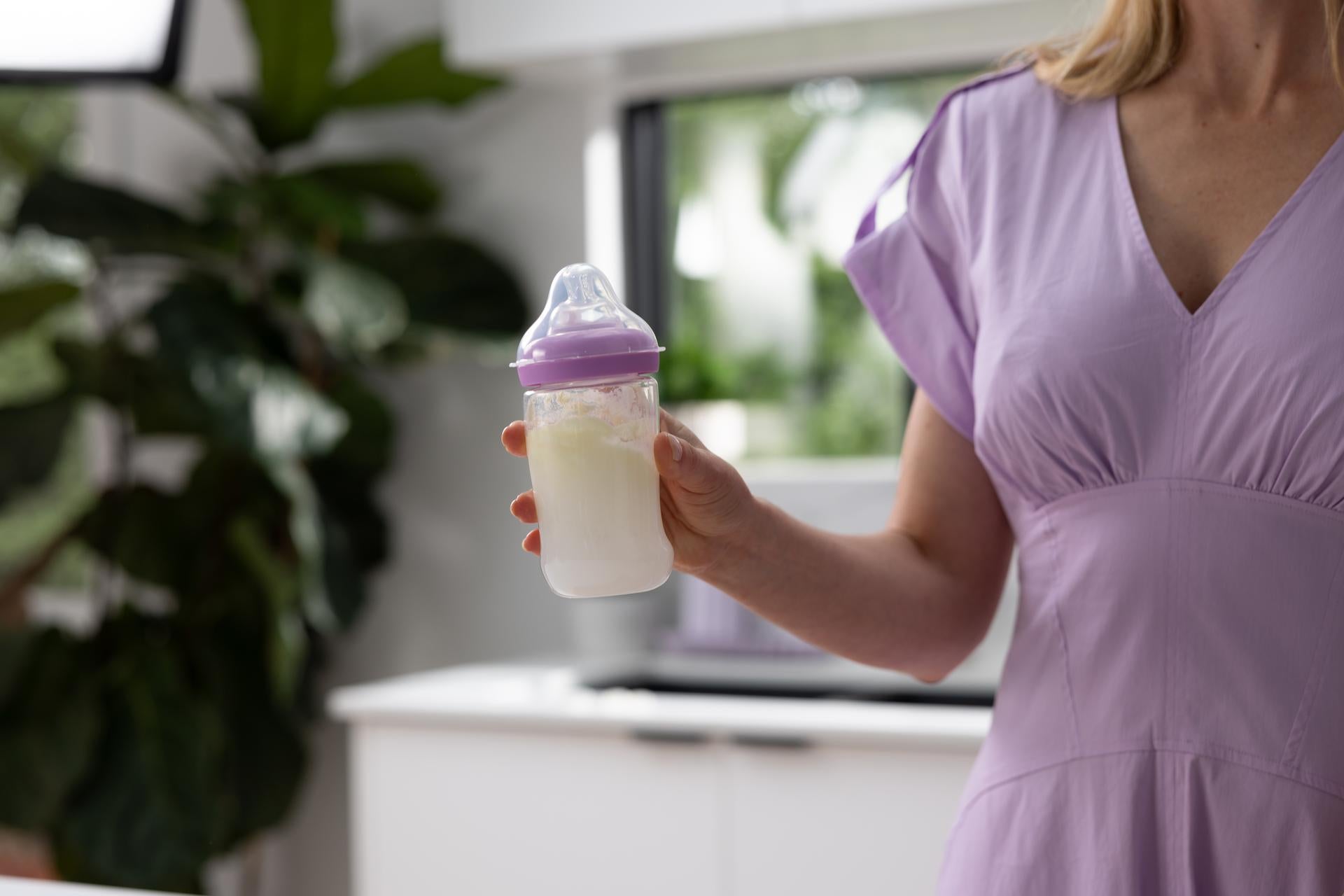
Formula Types & Clinical Indications
| Category | Protein Source / Processing | Indication | Example Label Wording |
| Standard Stage 1/2 | Intact cow-milk protein | Healthy term infants | “Infant Formula” |
| A2 β-casein | Milk from A2A2 cows | Possible GI sensitivity | “May be easier to digest*” |
| Anti-reflux (AR) | Added rice starch | Mild reflux | “For regurgitation” |
| Lactose-reduced | 20–50 % less lactose | Transient lactose intolerance | “Lactose-reduced” |
| Extensively hydrolysed | Peptides < 3 kDa | Mild–moderate CMPA | “Hypoallergenic” |
| Amino-acid | 100 % free amino acids | Severe CMPA / FPIES | “For severe allergy” |
| Soy-based | Isolated soy protein | Galactosaemia; vegan choice | “Soy Infant Formula” |
“May be easier to digest”
FSANZ allows qualified structure-function statements supported by peer-reviewed evidence.
Deep-Dive: A2 β-Casein Benefits & Limits
- Mechanism – A2 protein lacks histidine 67 → no BCM-7 peptide release → potentially gentler on gut.1
- Evidence – RCTs show softer stools & less discomfort vs conventional formula.2
- Limits – Not suitable for diagnosed CMPA; still contains cow-milk protein.
Prof Sarah Lin, Paediatric Allergist“A2 formula is a valid first-line option for non-specific GI discomfort, but allergic infants need specialist assessment.”
Reading the Tin: Decoding the Label
(Raising Children Network guide) (LINK NEED TO BE UPDATED)
- Mechanism – A2 protein lacks histidine 67 → no BCM-7 peptide release → potentially gentler on gut.1
- Evidence – RCTs show softer stools & less discomfort vs conventional formula.2
- Limits – Not suitable for diagnosed CMPA; still contains cow-milk protein.
| Label Section | What to Check | Red Flags |
| Nutritional panel | DHA ≥ 0.3 % of fatty acids; Iron 0.45 -0.8 mg/100 kcal | Added sucrose |
| Warnings | “Breast milk is best”, mixing instructions | Missing WHO statements |
| Use-by date | Must be legible | Rubbed off |
| Country of origin | NZ/AU strict QA | Unregulated imports |
| Batch code & QR | Enables trace recall | None present |
Safety Alerts & Recalls
Subscribe to FSANZ food-recall notices. Our automated system checks lot codes nightly and emails parents if their registered tin is affected.
Cost vs Clinical Efficacy
| Formula Type | Avg Cost / 800 g | Daily Cost (0-6 m) | Notes |
| Standard | A$23 | A$2.30 | Baseline |
| A2 β-casein | A$36 | A$3.60 | Premium for herd segregation |
| Hydrolysed | A$42 | A$4.20 | PBS partial subsidy |
| Amino-acid | A$55 | A$5.50 | Often subsidised with script |
Switching Protocol: Safety Steps Recap
- Consult HCP – Confirm diagnosis & formula type.
- Check label & batch – Verify expiry & QR.
- Gradual transition – 7-day mixing schedule (see Transitioning Between Formulas guide).
- Monitor symptoms – Log stool, rash, sleep for 14 days.
- Follow-up – Review with GP/dietitian; adjust volumes.
Breastfeeding Reminder
Breast milk is best for babies. The a2 Milk Company® supports exclusive breastfeeding for the first six months and continued breastfeeding for as long as mother and child desire. Responsive cue based feeding applies to breast and formula fed infants alike.
Need personalised guidance?
Call our a2™ Careline — Free, Monday to Friday, 8 am – 5 pm AEST
1800 22 46 32
[email protected]
References
- Ho S & Nguyen L. Digestive differences between A1 & A2 β-casein. Nutrition Science Review 33(2) (2022): 142-150.
- Jiang J et al. Infant comfort on A2-only formula. J Paediatrics 29(4) (2020): 211-219.
- Food Standards Australia New Zealand. Standard 2.9.1 – Infant Formula (2023).
- ASCIA. CMPA Management Guidelines (2023).
© 2025 Inside Scoop – Feeding advice you can trust
Share


Caption if needed


